
This guide covers everything accredited investors need to know about 5111 maufrais - april '24 update—from Austin market context and tax considerations to due diligence questions and next steps with Liquid's Opportunity Zone funds, bonds, and development projects.
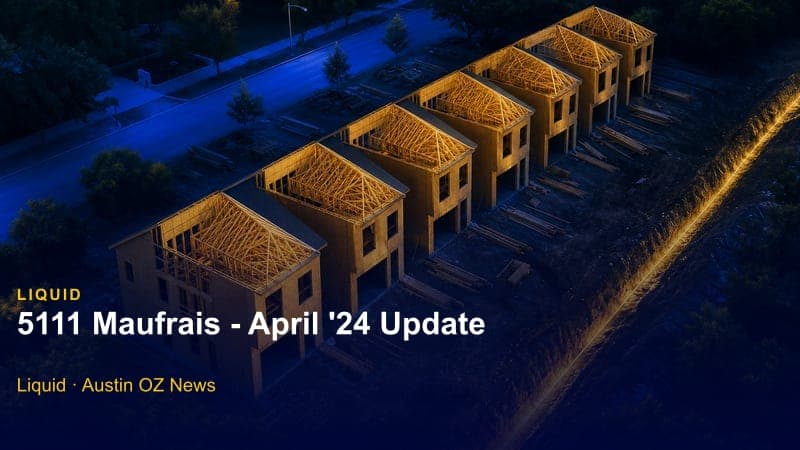
April 2024 – Project update for 5111 Maufrais Ln, one of our ground-up residential constructions projects in Austin, TX. Now featuring six residential homes!
Highlights:
- Increase to 6 Single Family Homes
- All homes to have 4 beds and 3 baths
- How the HOME initiative has helped us
- Current situation with utility easements (moving a service line)
- Why we’re doing two phases
- Update on sub-division process
- Seeking construction financing right now
Things we forgot to mention:
- Addressing seems to be taking a long time at the City of Austin right now. could be delayed as a result of this
- Yes, there is a Bond available for this project offered at 12% APR.
OTHER RESOURCES
Video Transcript
Alright, hey folks, this is an update on the five one-one-one-move-frame project. This is the first time I’ve done this, so excuse the composition of this recording, but we’ll see how we do.
Some things have changed in the, uh, the project of the course of the last year and a half. In particular, some of the different things that have happened at the city of Austin have resulted in some changes to our plan for the project.
So we’ve sort of had to adjust to what the city has given us and some of these things have been good and some of them have been you know difficult but all in all I think it’s mean going to result in us getting a better product for the fun generally. Let me walk through exactly what that means. At the end of last year The city of Austin passed the home initiative.
The biggest thing that happened in the home initiative is that all residential lights in the city of Austin went from being, having the ability to build two units with a very reduced footprint for the second unit to three residential units, so basically combining all of the different single family zonings from the city, SF-2, SF-3, SF-1s into this one sort of bundle called SFR or single family residential, which allows you to build three units.
Now there’s challenges with that. You don’t necessarily get all the same compatibility stuff. There’s limitations on the floor area ratio of the impervious cover that you still have to work within. So it doesn’t mean you can just build three huge townhouses, but some restrictions been reduced, like for example, the tent that used to exist is no longer a thing, maximum building height goes up to 35 feet, so you can potentially have a livable third floors now.
It’s going to markedly change how builders across the city construct and it’s going to markedly change the product that’s available. That’ll be good for a lot of people and it’ll be sometimes maybe a little bit less suitable for certain types of buyers. But that’s just the reality of where we’re at.
When the city did this, we decided for the Maufrais project that we were going to try and use the home initiative to increase the number of units on the five triple one-millimeter project. So we went from originally looking at building something like two duplexes on two different lights to now we’re going to construct six four-bedroom homes or kind of like in a townhouse layout on the side.
This still requires the same sort of paperwork for a subdivision. So we’re still going to move forward with the subdividing into a lot, one and a lot too. But we are going to be able to have sort of a single driveway to handle left-hand side and then a phase development of three units on the front, a lot and then three units on the backboard.
We’ll all be in the same sort of structure, same layout, same footprint, nothing changes terribly. on that. So we can reuse all of our engineering and things. But it doesn’t mean we have much, much greater density and a much higher unit count. It’s originally, you know, this site would have only supported two units.
We’ve effectively tripled the capacity of the units and increase the square footage of those units as well. There’s a death of four-bedroom housing across Austin. It’s incredibly hard to lease, it’s incredibly hard to buy. The four-bedroom product is overly expensive to the point where sometimes rental premiums are upwards of 60% for a fourth bedroom, which is just crazy. We think we’re building a good product here, we think it’s going to have product market fit and we’re pretty excited about it.
TEAM
Architect
Let me go through and explain who we’re working with. So we have a design firm called Baron Custom Design, a Felicia Foster at Baron Custom Design, an excellent architect who’s been rewrite to the land development code at the city of Austin for a significant period of time now. Felicia was behind some of the biggest innovations at the city with respect, designing and compatibility is incredibly creative on what she can produce. We’re working with her team on the 5111 Maufrais Ln project for almost a year and a half now. So her design will be the one that is implemented on all six of the homes.
Builder
Then our builder is 360 construction, they’ve come a foot over with them. He’s a partner in the fun. He’s going to be the general contractor. He has a four or five person team of salaried employees that are part of that construction unit that we’re going to be utilizing and they’re ready to go.
We’ve got plans submitted at the city with approval for the first three units. We’re just waiting on confirmation of the subdivision in order to be able to submit plans for the second half, which is the back three units.
There’s a little bit of a hiccup with what’s being the reason that’s the held up right now is if you look at this permit set of plans that were submitted to the city, you can obviously see the renderings here, but you’ll notice that there’s a flag lot that’s been created here such that we can develop the site that way that we want to. The challenge we is that down in this corner of the side is a electrical service pole utility that is impinging on the driveway.
That service pole doesn’t actually serve as our property, it serves as the neighbor immediately to the plant self. So we’ve got to have that moved and we can gauge someone to do that.
So we’re in the process of moving that pole now, but that pole and plans for the service to the neighbor have to be a driver prior to completion of the subdivision, which means that we can only submit for the first three homes initially, then we’ll go back and we’ll submit for the second three homes.
We could still build them all at the same time, but it sort of depends now on just financing and how that sort of stuff works out as to whether or not we just start everything or whether we start three.
Either way, starting three or still work. So, as soon as we can get that moved, our max, our civil engineer will have subdivision done, and we’ll be off and racing.
Everything else is approved there. So let me go back to, let me go back to our plans here. Okay, so the current status of the project is waiting on that subdivision, we’re trying to confirm financing for a construction line, We’re waiting for a final approval for all of the plat, and then we’re going to be, as soon as we can finalize construction, we’ll be able to start with development. Besides already been, the previous structure that was on the site has already been knocked down.
So we’re kind of ready to go with, with development, some minor grading needs to be done, and then some site prep stuff, obviously for all the utilities, but all that flatwork is going to be relatively easy on this site, because there’s no trees or anything. So yeah, we’re ready to go. Sums are all set up, just need to find a nice financing.
On the financing site, obviously things have changed a little bit because we’re increased the construction budget fairly considerably, because we’re now building six full single family homes, all with four bedrooms, higher bathroom counts, more kitchen, right, more roofs, it all adds up.
So the construction budget is going to increase to about $2.6 million. That still leaves us in a pretty good shape.
It’s really just a question for us now, obviously being in OZ fund, what do we decide to do on the backend with the project, right?
Because we can sell some units to reduce our cost basis, or we can obviously hold on to as many as possible, because given the amount of money that we are given the amount of equity that we should be able to create, we want to keep as many units for leasing as possible long-term.
So we’ve priced out a few different options here for the sale of the units. We think that if we sell four we can get this project after having a cap rate of almost 40%.
That would mean holding on to two. If we can sell three, however it might make a little bit more sense because that means we could sell three on one site and we could keep three on one of the other legal lots as well.
We also have the option to just lease all of them long term if we can get some attractive financing. But that’s two years down the road, most likely, getting post construction re-fire.
Not sure how the interest rates are going to look at that time. If they look really attractive, we’ll be in a position to sell fewer of these units.
But either way, we have really good exit options here on the back end through sale of some, sale of all, sale of none, right?
So if the project works either way, I’m pretty confident that we’ll do well on this. So so as we can get a construction loan, it be often going with that.
That’s the update on the finances currently. The only addition that I’ll make to that is we’re looking at buying out the existing bridge loan.
So we have a to buy that out on June 1st, which is a capital commitment of about $360,000, so major investors will be asked if they want to contribute to that.
I think they’ll be inclined to, that’ll mean that we own this free and clear as opposed to being financed and we should be able to have an easier time of going to get construction financing, especially given the new plan with the about.
I think that’s it. Obviously if you’re interested in contributing more to the fund or to this project generally you can feel free, my contact information is at the bottom so we can talk about it anytime just give me a call and expect a new update on another project sometime next 24 48 hours.
Cool, thanks guys.
Executive Summary: 5111 Maufrais - April '24 Update
5111 Maufrais Ln - project update April '24 including development plan, status of project with COA and subdivision procedures. For accredited investors weighing Austin real estate, federal tax incentives, and fixed-income alternatives, understanding 5111 maufrais - april '24 update is a practical first step before reviewing fund materials or offering documents.
Liquid's team publishes research and project updates so investors can connect macro trends—population growth, housing supply, IRS guidance, and local entitlement reform—to specific decisions about capital gains reinvestment, bond allocations, and Opportunity Zone fund commitments.
Market Context in Austin, Texas
Austin remains one of the most closely watched U.S. housing markets. After rapid appreciation in 2020–2022, buyers and developers adjusted to higher interest rates, normalized inventory, and selective rent growth. Opportunity Zone tracts east of Interstate 35 continue to see infill activity because land costs, renter demographics, and corridor access support value-add and ground-up residential strategies.
For investors, Austin's appeal is not only price appreciation but also employment diversification, migration inflows, and policy debates over density and affordability. City Council initiatives—bonus density programs, infill tools, and changes to review processes—directly affect project timelines in OZ neighborhoods where Liquid operates.
Neighborhoods such as Parker Lane, Montopolis, East Oltorf, and Windsor Park offer contrasts in age of housing stock, ownership rates, and proximity to employment centers. Underwriting therefore requires tract-level analysis rather than MSA-wide averages alone.
Deep Dive: 5111 Maufrais - April '24 Update
When evaluating 5111 maufrais - april '24 update, start with the investor problem being solved: deferring or reducing capital gains tax, earning current income, gaining exposure to Austin residential real estate, or diversifying beyond public markets. Each objective implies different liquidity, hold period, and documentation requirements.
Qualified Opportunity Funds must meet IRS asset tests and follow rules for qualified Opportunity Zone property and businesses. Sponsors should demonstrate not only tax compliance but also construction competency, capital stack discipline, and transparent reporting. Liquid's model emphasizes Austin infill and rental stabilization in designated tracts, with regular news updates on entitlements and capital raises.
If your question is specifically about 5111 maufrais - april '24 update, map how it affects timing (180-day reinvestment windows, 45-day 1031 identification), risk (development, lease-up, interest rate sensitivity), and exit (1031 continuation, QOF 10-year exclusion, or note maturity). Professional tax and legal counsel should validate any strategy against your facts.
Tax and Structuring Considerations
Opportunity Zone benefits include temporary deferral of eligible gains, potential reduction of deferred gains with long enough holds, and possible exclusion of new QOF investment appreciation after 10 years. These benefits interact with federal deadlines—notably the deferral recognition date—and individual state tax treatment, which may differ from federal rules.
Investors comparing 1031 exchanges should note like-kind real property requirements, equal-or-greater debt replacement constraints, and the inability to defer non-real-estate gains. Opportunity Zone investing accepts a broader range of capital gains sources but requires equity investment in a QOF rather than direct property replacement.
Bond investors evaluating zero coupon structures should model returns on a yield-to-maturity basis, understand how private offerings differ from FDIC-insured deposits, and confirm accredited investor eligibility. Offering documents describe use of proceeds, collateral or security features if any, and payment timing.
Due Diligence Checklist
Request and read the PPM, subscription agreement, and any supplements. Verify sponsor track record on entitlements, budgets, and investor communications. For development-heavy strategies, inspect site control, plan status with the City of Austin, and realistic construction timelines.
Stress-test assumptions: rent comps, exit cap rates, hard cost inflation, and lease-up pace. For tax-driven strategies, model both federal and state outcomes and identify key dates that trigger recognition events.
Ask how reporting works—annual K-1s, project newsletters, audited financials if available—and whether the strategy matches your liquidity profile. Liquid encourages direct conversations for investors comparing bonds, QOF II equity, or hybrid allocations.
Looking Ahead
The themes behind 5111 maufrais - april '24 update will continue to evolve with IRS guidance, Austin land development code updates, and capital market conditions. Investors who stay informed through primary sources—IRS FAQs, City of Austin Development Services, Census demographics—and sponsor updates are better positioned to act within critical deadlines.
Liquid will continue publishing news on projects, policy changes, and educational topics so investors can connect portfolio decisions to local market reality. Whether you are exploring your first QOF investment or comparing bond yields to savings accounts, start with education, validate with professionals, and invest only when documents and risk tolerance align.
What This Milestone Means for Investors
Development milestones—plan approval, subdivision submission, fundraising kickoff, or pricing updates—signal progress through Liquid's standard project lifecycle. Each step reduces entitlement uncertainty and clarifies construction timing, capital needs, and projected stabilization.
Investors in Liquid funds benefit from transparency as projects advance through City of Austin Development Services. Site plans, subdivision plats, and building permits are public record, and Liquid supplements those filings with direct investor communications.
When evaluating a project update, consider how the milestone affects budget, schedule, and comparables in the surrounding submarket. Approved plans enable vertical construction; subdivision acceptance unlocks lot splits; fundraising opens align capital deployment with concrete acquisition or build timelines.
| Phase | Status Indicator | Investor Relevance |
|---|---|---|
| Land control & design | Complete / in progress | Capital deployed; entitlements underway |
| Entitlements approved | COA sign-off received | Construction timeline firmed |
| Vertical construction | Foundation to finish | Budget and schedule monitoring |
| Lease-up or sale | Stabilization | Return profile realized |
Related Resources on Liquid
Further Reading
Frequently Asked Questions
- What is 5111 Maufrais - April '24 Update and why should investors care?
- 5111 Maufrais - April '24 Update sits at the intersection of Austin real estate, federal tax policy, and long-term wealth building. Investors evaluating this topic typically want clarity on how it affects capital gains treatment, project timelines, neighborhood fundamentals, or fund structure. Liquid publishes educational content so accredited investors can compare strategies before reviewing offering documents with their advisors.
- How does this relate to Opportunity Zone investing in Austin?
- Austin's designated Opportunity Zones span neighborhoods east and southeast of downtown where housing demand, job growth, and infill development continue to attract capital. Liquid focuses on single-family and small multifamily projects in tracts including Parker Lane and Montopolis, combining local entitlement expertise with QOF compliance so investments may qualify for deferral, reduction, and exclusion of eligible gains when holding requirements are met.
- Who is the typical Liquid investor for this topic?
- Liquid investors are typically accredited individuals who recently realized capital gains from business sales, real estate dispositions, stock positions, or other appreciated assets. They seek tax-efficient deployment into tangible Austin real estate rather than passive index exposure alone. Some investors prioritize fixed-income style returns through zero coupon notes; others prioritize equity-style appreciation through QOF investments.
- What should I review before investing with Liquid?
- Review the Private Placement Memorandum, subscription agreement, and fund-specific materials for any offering you consider. Confirm your accredited investor status, understand liquidity terms, and discuss tax implications with a CPA or tax attorney. Liquid's team is available to answer process questions, but individualized tax or legal advice should come from your professionals.
- Where can I learn more about Liquid's funds and projects?
- Start with the funds page for QOF II overview materials, the bonds page for zero coupon note terms, and the projects page for active development updates. The Austin Opportunity Zone map shows tract boundaries. You may also contact Liquid directly through the investor inquiry form to discuss fit and next steps.